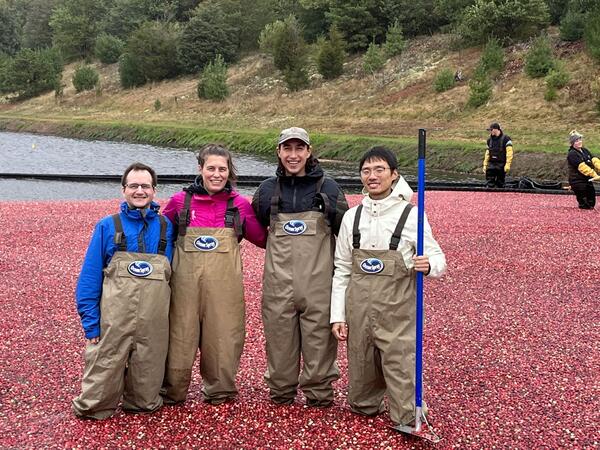
The Intergovernmental Panel on Climate Change identifies significant opportunities in agriculture and forestry land and practices on those landscapes to mitigate carbon emissions and enhance carbon storage. These lands are also a critical resource for biodiversity, livelihoods, economic stability, and more that can be enhanced through sustainable management. YASSP works to enhance the body of research for sustainable land use in the following projects.
Evaluating the Evidence Behind Soil Carbon Models
We examine the empirical foundations of soil carbon models used in carbon accounting and climate policy. While process-based models are widely used to estimate how agricultural practices influence soil carbon, they are often calibrated using a limited set of small, highly controlled experiments that may not reflect real-world farming conditions. We analyze the studies underlying these models through evaluating their geographic relevance, experimental design, and alignment with modern management practices. The goal of this work is to reconnect models with robust, externally valid empirical data. By identifying gaps in the current evidence base, we help guide the development of new study designs and datasets capable of validating model predictions under real-world conditions and ensure that carbon accounting systems are grounded in measurable, causal outcomes.
Data Partnerships & Evidence Development
We are building partnerships with companies, carbon farming initiatives, and producer networks to leverage the value of real-world soil and management data. Working across commercial operations, we analyze soil data to build an empirical foundation for understanding how practices perform at scale. Using these data, we evaluate how existing sampling and monitoring approaches perform in practice and identify opportunities to integrate causal study designs into ongoing programs. This includes improving how data are collected, structured, and analyzed so that management effects can be distinguished from background variability. The goal is to turn project-level data into cumulative evidence and help support better measurement systems, inform future study design, and strengthen confidence in carbon markets by grounding claims in transparent, real-world outcomes.
Causal Evaluation of Agricultural Practices at Regional Scales
In collaboration with Environmental Defense Fund (EDF) and Hudson Carbon
This project develops and tests causal study designs to determine how agricultural management practices influence soil carbon and soil health across working farms. Using the Hudson Valley, NY as a testbed, we select comparable fields based on soil texture and baseline carbon conditions, allowing us to isolate the effects of management from underlying environmental differences. By combining repeated sampling with regionally coordinated study design, we evaluate how to confidently detect management-driven changes despite high natural variability in soils. The work identifies how many fields are needed, how often they should be resampled, and which analytical approaches best distinguish causal effects from sampling noise. These results provide a foundation for scalable, evidence-based systems that link farm practices to measurable outcomes by supporting more credible carbon accounting and better-informed decisions by producers, companies, and policymakers.
Lethal and sublethal effects of a “bee-safe” pesticide on alfalfa leafcutter bees
Sulfoxaflor is a relatively new insecticide marketed as “bee-safe” by the EPA. This project is reporting on data collected by the USDA-ARS Pollinating Insects Research Unit and researchers at Utah State University that finds that alfalfa leafcutter bees, an important agricultural pollinator, are more sensitive to negative effects of sulfoxaflor than honeybees, and current EPA regulations for sulfoxaflor application in certain crops are not sufficient to protect non-honeybee pollinators.